
The content of the article
Nightingale has long been recognized as a bird that sings more beautiful than any other species of birds. In her voice there is a rumble and a whistle, which eventually merge into a beautiful song. If you hear this bird in the forest, you cannot confuse it with another. But the appearance of the nightingale is absolutely inconspicuous.
Description
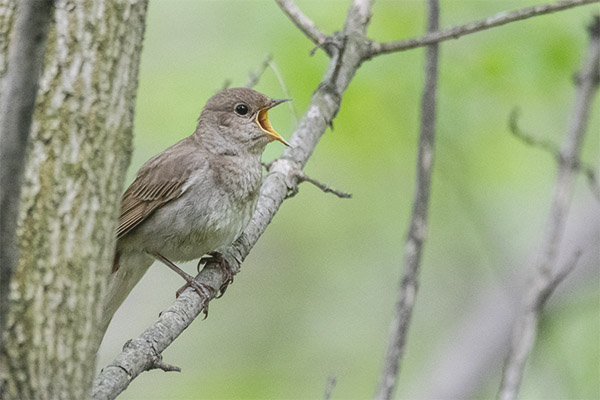
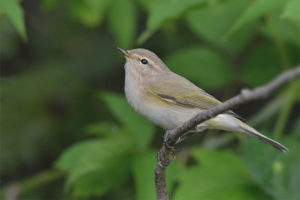
When we hear this bird, but do not see it, it seems that it looks as bright as a beautiful exotic flower. But in fact, the representatives of this species are quite inconspicuous. They have no bright color plumage. The bird is quite small in size. Her paws are small and thin, and her eyes are large and black.
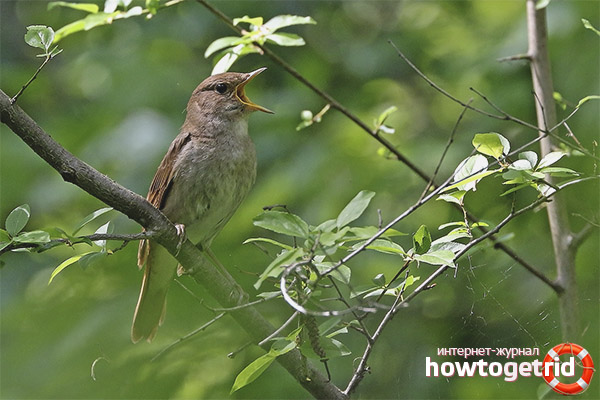
The color of plumage depends on the species to which the bird belongs. Representatives of the species Nightingale ordinary has plumage almost monophonic. It is brown, sometimes brown with a hint of olive.On the abdomen there is a white spot. On the sides and chest, the plumage is the same as throughout the body, but somewhat darker.
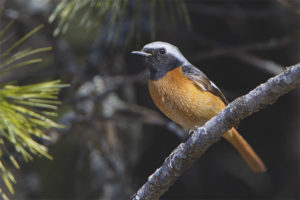
The tail is straight, reddish. Some individuals have a rounded tail. Some species have a brighter coloring on the chest. The plumage in this area may be bluish, black or orange.
Males and females are almost the same. The male is slightly brighter in color. Nestlings are more variegated or spotty. This coloring helps them hide from danger.
The bird weighs about 25 g. The length of the body of a nightingale is about 18-20 cm. The length of the wings is about 9 cm. And the span is up to 28 cm.
Habitat
These birds can be found in many parts of the world. Each species of nightingale occupies its own habitat.
- In Europe, in Siberia, representatives of the common nightingale species can be seen.
- Blue Nightingale lives in the area of the Ob River. They also inhabit the Sea of Japan.
- In Kamchatka, Sakhalin, you can see the whistling nightingale.
- In the Far East, a species of red-faced nightingale lives. You can also meet birds of this species in Siberia.
All nightingales that live in regions with frosty winters fly to warmer countries.
This bird lives in the forest or in the bushes on the edge. You can see them in the city parks, where willows grow and there is a pond nearby. At a short distance from the nest you can hear the beautiful song of this bird.
Lifestyle
Nightingales are divided into migratory and sedentary. Those populations that live in a warm climate do not need to fly away for the winter. The rest of the period of frost fly to other countries.
For wintering, they choose East Africa. In the spring they return. It takes place in April-May. Some of them fly to nesting sites even in early June. At this time, the trees are already covered with leaves, and there are enough insects that make up the main diet of birds of this species. The first to arrive are adult males. They begin to sing fuzzily, announcing the return.
After that young individuals arrive. They love to settle closer to their experienced brethren. But adult nightingales protect the place around their home. They themselves determine who will be their neighbor. Not far from the old nightingale, as a rule, live young individuals. As a result, a peculiar hierarchy is formed.
The distance between sockets is usually 25-30 m.
Singing
If the nests of two individuals are close to each other, the birds sing in a certain line. Walking through the forest, we can often hear the trills of about 40 of these birds at once. Starts the song is the oldest and most experienced.
If the young representative suddenly starts singing first, then the old one will immediately chase him away and will sing even louder. If the nests are at a sufficient distance, each individual should sing at one time. The young nightingale sings not as beautiful as the more experienced. They learn from their mentors gradually.
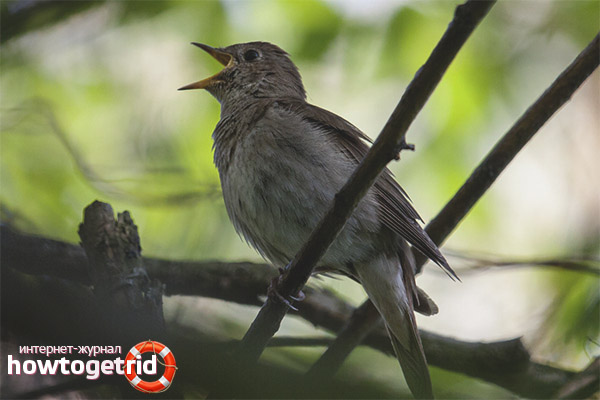
Usually it is rather difficult to see this bird. They often hide, but if you look closely, you can see it in a tree. They sing, having widely opened the beak.
They can sing at least for days. At night, when many other sounds are absent, the song of the nightingale is heard most clearly.
With the help of their singing, they can send different signals. If several signals come together, this means that the bird is very disturbed.
Breeding
As soon as the nightingales arrive from the wintering grounds, they first rest for several years.When the birds get used to the terrain, they begin to look for a pair for themselves. To attract the "bride", the nightingale sings tirelessly. He is only occasionally interrupted to find food for himself. In addition to songs, the male uses other ways to attract a pair. He spreads his tail, is hunched or becomes in various poses.
Early in the morning, females begin to whistle to draw attention to themselves. After individuals of opposite sexes choose each other, the female takes off into the air. The male at this time begins to catch up with her, at the same time, making peculiar creaking sounds.
After that, the female proceeds to the arrangement of the nest. At the same time, the male continues his beautiful song, which already says that this territory and the female are occupied.
Usually nightingales build their nests near the reservoir. They place them on shrubs at a height of about a meter. Sometimes the nest is right on the ground. To do this, they do not dig a hole, but simply make a small depression in the foliage. The nightingale's nest is crude. The female lining it with foliage, and at the edges - grass stalks. To build a nest, the female takes about 7 days.
Then she lays eggs. In one clutch, as a rule, no more than 6 of them.They are brownish in color with an olive tinge. Expectant mother is also engaged in incubation. It occurs within 2 weeks.
When the chicks hatch, the male no longer needs to attract attention. So he pauses. They nestle chicks together, bring them food.
Care lasts about 2 weeks too. First, the chicks are moved on foot. They are very careful, they are not removed far from home. By the end of the summer, they are already capable of flying, and in the fall they fly away with their parents.
These birds live for about 3-4 years. In captivity sometimes live up to 7.
Nutrition
These birds feed on various small insects. Sometimes they can eat cereals, as well as some fruits and berries.
Captivity
Previously, their catch was illegal. At the present time, the nightingale is often kept in captivity. Catch them in the spring. Having caught, they are tied so that the bird could not flap its wings. At first, she does not sing because of stress, and then gradually gets used to it.
Over time, the nightingale adapts to the cage, but does not become tame. For them it is necessary to prepare a spacious cage. To the nightingale did not gain weight, it is better if it is an aviary.
At first, the bird tries to break free. They can be injured by hitting the bars. Therefore, from the inside, the cage is better covered first.
What to feed
- About 8 powdery worms per day.
- Ant eggs.
- Chicken eggs.
You can add boiled meat, carrots, salad. Feed should be crushed. When the bird gets used to the new place, you can give store food.
The song of the nightingale is definitely beautiful. But in captivity the bird feels bad. It is best to enjoy their voice in nature, and going to the forest will benefit all members of the household.
Video: Common Nightingale (Luscinia luscinia)
To send